
Chapter 203: Lost Libraries
“Every personal library is a reading project,” wrote the Spanish philosopher José Gaos, a wonderful excuse to bite off more than we can chew, acquiring yet another item for our increasing to-read list. Like all projects, this one loses pieces along the way, shedding books with every change of address. Having shed more than my share, I’m envious of those who have all their books in one place.
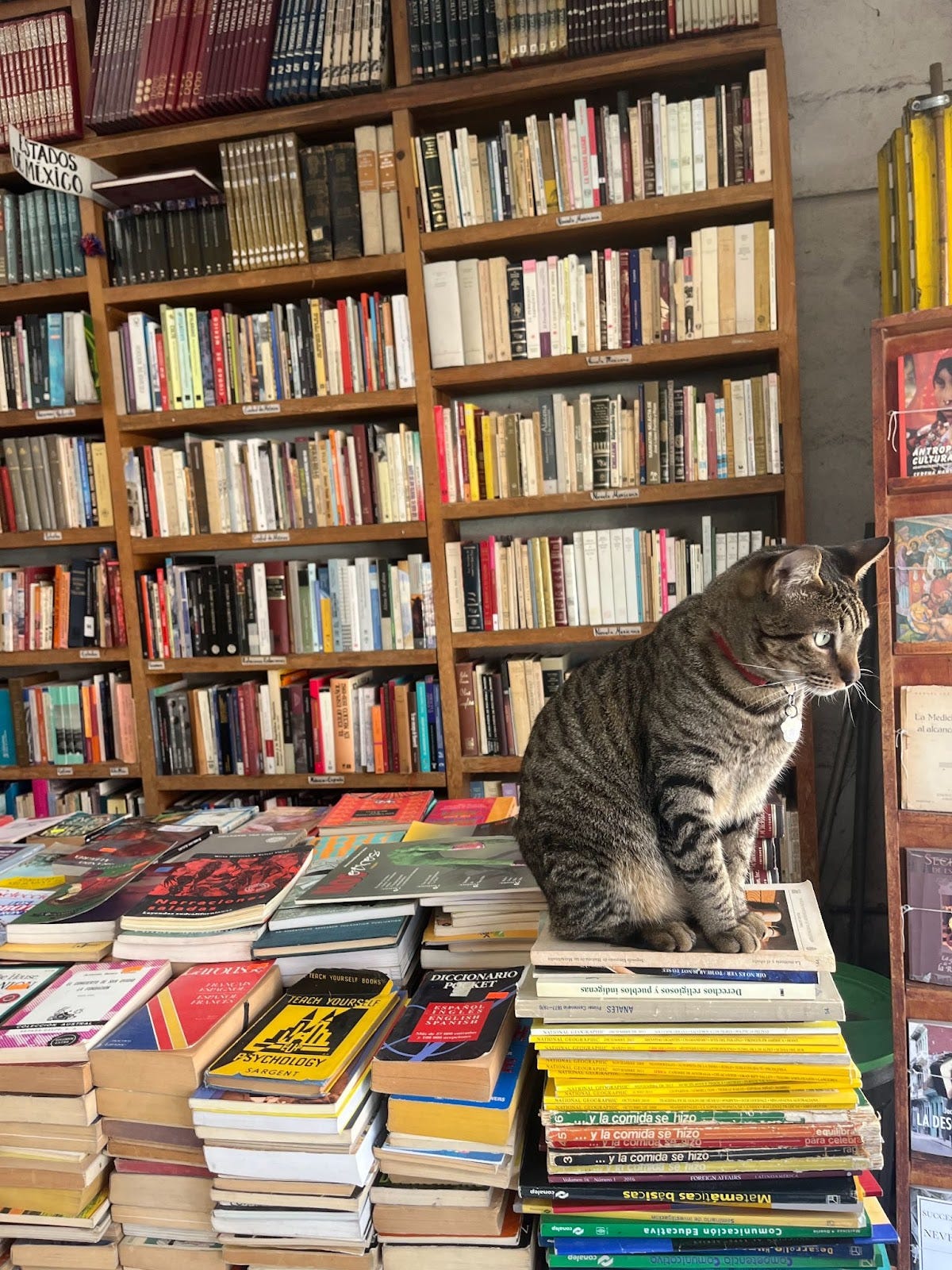
Whenever I’m let loose in someone else’s home, I usually head for the bookcase. My impoliteness dawns on me, eventually, but as recently as last week, I was as happy to visit a friend I hadn’t seen in years as I was thrilled to rediscover his ceiling-high collection of words.
I’ll justify this with another quote, from So Many Books, by Gabriel Zaid: “Each reader’s unique personality flourishes in diversity and is reflected in their personal library…Every reader is a world unto themselves: no two personal libraries are identical.” Rediscovering my friend’s library was a way of getting reacquainted with his old tastes, and where reading has led him in the ensuing decade.
We envy what we lack, and it’s not a contradiction to be grateful for a movable life while remembering the countless hardbacks left by the wayside. The titles we leave behind come back to haunt us, every once in a while. We find copies of them here and there, in bookshops or elsewhere, and feel guilty for having discarded them, opting to preserve something else in the overstuffed suitcase.
Maybe life would be easier with going digital, but books have an air of durability about them, as websites come and go, old stories are deleted, and the bolted door of “HTTP 404 - File not found error” tells us a text is no more. There is little left of the early Internet, but any library holds books that outdate us all. Maybe life is lighter with a Kindle, but we’d lose the choices we make. And what they teach us.
I remember two departures that made parting with books meaningful. Some time ago, as I was leaving New York, I visited a previous apartment where I had left a year’s worth of reading due to the lack of furniture in my next living quarters. As the likely inheritor of what was already in her living room, the roommate who had replaced me took an active part in parsing through what I could salvage. It turned out to be an enlightening experience. She was a book critic, and what could have been a niggling process instead became an impromptu lesson in literary criticism.
Years later, in Washington, D.C., having accumulated a small library, I had to abandon most of it due to a change of plans. I was saying goodbye to a city, to many sandcastles of reading aspirations, research, and article ideas for which those books had been purchased. That neighborhood was full of Little Free Libraries – those quaint miniature tree houses shaped like mailboxes – where you can leave or take as many books as you can hold. I enlisted a friend by asking if she also had books to donate. She did, for much more poignant reasons than I did. When we met in front of the first stop, carrying heavy Ikea bags to be emptied, she took out a book and handled it carefully. I was surprised to see a highly technical title that did not relate to her interests. They were her father’s books, she explained after a pause. He had recently passed away. She could not keep his books, but made a point of giving each its due, saying a few words about what they had meant to him, before sending them on their way.
What happens to books after we leave them? I once met a man who knew. His name was Guillermo, and he was a student in Mexico City who made extra cash peddling books, all of which were startlingly good. When asked where he found them, he answered that it was “among the book destroyers,” a poetic way to say he sought them among the city’s vast paper recyclers. There, tons of paper products were pulped, and he sifted through the paperbacks on death row, rescuing what he could.
Is it worth having all those books if that’s how most might need to end, despite Guillermo’s efforts? Can we actually enjoy all the books we ever own?
One answer to that can be found in Argentina. It’s the strange tale of a man who loved books beyond any possibility of reading them.
Jorge Luis Borges was appointed director of his country’s National Library in 1955, just as he went blind. “There was I, in some way, the center of 900,000 volumes in various languages. I discovered that I could hardly make out the title pages or the spines. I then wrote ‘Poem of the Gifts.” It reads as follows:
No one should read self-pity or reproach / into this statement of the majesty / of God, who with such splendid irony / granted me both the books and the night / Care of this city of books he handed over to sightless eyes (…) In shadow, with a tentative stick, I try / the hollow twilight, slow and imprecise — / I, who had always thought of Paradise / in form and image as a library.
He served with distinction for 18 years in his unseen paradise, inspired by wandering through it.
It’s one of the truest examples of the pleasure that some can derive from living among books, beyond the ambition of reading them, taking comfort in their mere presence. As Montaigne wrote in the 16th century: “As a matter of fact, I make no more use of them, as it were, than those who know them not. I enjoy them as misers do their money, in knowing that I may enjoy them when I please: my mind is satisfied with this right of possession…(My library) ’tis there that I am in my kingdom, and there I endeavor to make myself an absolute monarch, and to sequester this one corner from all society.”
It is a misanthrope’s refuge, perhaps, and also a world in itself, where the objects speak to us when they are opened. And, who knows, maybe even between each other. This enticing idea was posited by the curious Mexican writer Julio Torri, who wrote that he had witnessed it himself, heard it, “not as an invention of my understanding nor with the mind clouded by the vanities of wine.” What he goes on to relate is what two books say to each other, away from prying ears, when separate volumes of the same work are reunited in a library.
Torri’s text is a play on the intimate connections that start to form as we fill our bookshelves, and it might not be so outlandish at all. I know for a fact that some of my relatives and acquaintances who have written books get along better on the bookshelf than in real life, and it’s easier to imagine them crammed there than around a table. If anything, their books are more likely to talk to each other than they are!
For however long they remain intact, our bookshelves follow a logic all their own. In their tight embrace, they preserve the time we spent with each book, whether through mementos between the pages or marginalia. I know I’ve written many things in the margins of books, some to do with the paragraph alongside my notes, and others seemingly oblivious to it. I recently found in a book of serious essays by a Post-Structuralist philosopher that I had filled the space alongside his lofty ideas with musings about soccer. I can’t recapture the why, but I know that I could reread those arduous pages countless times without ever returning to green fields and balls being kicked with abandon. That reading of the text exists only in that copy, alongside the stray conversations overheard and jotted down, or the mysterious directions to forgotten places.
I rarely stumble upon those notes, yet they never fail to surprise me, and are sometimes not my own. An old edition of Natalia Ginzburg’s Family Lexicon bears my mother’s handwriting, marking the date and place where she read it while being pregnant.
That uniqueness is all the more reason to cherish books and want to keep them, as reminders of our past and a sense of belonging. Sartre makes this point in The Words, his autobiography. “I began my life as I shall no doubt end it: among books…Even before I could read, I already revered these raised stones; upright or leaning, wedged together like bricks on the library shelves or nobly placed like avenues of dolmens, I felt that our family prosperity depended on them. They were all alike, and I was romping about in a tiny sanctuary, surrounded by squat, ancient monuments which had witnessed my birth, which would witness my death, and whose permanence guaranteed me a future as calm as my past. I used to touch them in secret to honor my hands with their dust.”
If the family library can hold a shared past, it can also divide. One of the great wedges that split my maternal side was the “disappearance” of my mother’s books after she had left Mexico. My grandfather pleaded she leave them behind, that she not take them with her, “for then she would be gone for good”. And yet, as her sojourn became a life abroad, my grandmother emptied the bookshelves of their content, as if to say, you can come back, but you can never return.
It’s become obvious by now that, whether lost or preserved, I associate books with home. Libraries are touchstones, a singular place where we belong, making it all the more painful when they are truly lost, or worse, even willfully destroyed. Among the cruelest cases is that of Stefan Zweig, fleeing Vienna in 1934 with Nazism at his doorstep. After drifting through continents, he settled in Petrópolis, Brazil, in 1940. There he sat down to write The World of Yesterday, his memoir of all that was lost.
“Three times they have wreaked havoc with my home and my way of life, cutting me off from the past and all that it once comprised, and flinging me with dramatic force into a void where I soon became familiar with the feeling that there was nowhere to turn,” he writes. “My literary work, in the language in which I wrote it, has been burnt to ashes in the country where my books made millions of readers their friends.”
And as he faces this final effort to memorialize the vanished world he longs for, the absence of his library becomes even starker. “I write in the middle of the war, I write abroad and with nothing to jog my memory; I have no copies of my books, no notes, no letters from friends available here in my hotel room.”
Zweig mailed the completed manuscript to his publisher the day before committing suicide with his wife, Lotte Altmann, in February 1942.
Exiles such as this are the subject of another wandering author, Chilean writer Roberto Bolaño, who reflected in Literature and Exile on the sense of home and the books that fill it. “Books are the only homeland of the true writer, books that may sit on the shelves, or in the memory.” He revisited this idea in his final interview: “My only country is my two children and wife and perhaps, though in second place, some moments, streets, faces or books that are in me, and which one day I will forget.”
We might move again and again, pages might get lost, and memories might fade, but just like homes, however briefly, we can inhabit books. And come to think of it, they inhabit us for even longer.
* * *
If you have a question, a problem in your work, if you are feeling lost, stuck, confused, at sea, searching, grappling, or baffled, email me at Michaelshapiro808@gmail.com and tell me what you’re confronting and what help you need.
It is seldom, if ever, the case that one writer’s problem or question is their’s alone.
Please indicate if you want to remain anonymous, have your name or just first name included. I will include the question and then answer it as best I can.
* * *
Nothing good ever came from writers punishing themselves. We know writing is hard. We’re here to show that it doesn’t have to be torture
 | A guest post by
|